• Paper questionnaires are also available in seven foreign languages: Chinese, English, Korean, Portuguese, Spanish, Thai, and Vietnamese.
  • If you require a questionnaire in a foreign language, or if you have any questions, please call the Economic Census for Business Activity Contact Center (English support only).
    Toll-free number: 0120-138-102 (free of charge)
    Support available in Japanese and English
    If you cannot connect to the toll-free number (e.g., calling from an IP phone): 03-6628-3662 (charges apply)
    Support hours: 9:00-18:00 (closed Saturdays, Sundays, and national holidays)
  • An automated guidance message in Japanese will play at the start of the call. Press “3” to be connected to an English-speaking operator.

What is the
Economic Census?

Economic Census
for Business Activity

Purpose and scope

The Economic Census is aimed at all establishments and enterprises in Japan.
Purpose

The purpose of the Economic Census for Business Activity is to clarify the business activities of establishments and enterprises in Japan on both a national and regional level, by comprehensively capturing accounting items such as sales (revenue) and expenses across all industrial sectors at the same point in time.

Scope
  • All establishments and enterprises are subject to the census. This includes factories, cafes, and private offices.
  • In addition to basic items such as name, location, and management organization, the census surveys the business activities of enterprises, including a description of business, sales/expenses, and capital investment.
  • The census results serve as reference materials for policymaking and business planning, and are utilized to improve the lives of all citizens.

Targets of the census

What is an establishment?

In this census, an “establishment” refers to an entity that:

Operates under a single management agency (excluding group companies),
Occupies a fixed location (a specific plot of land),
Has workers and facilities, and
Continuously engages in business activities such as the production and sale of goods or the provision of services.

Examples of establishments include stores, inns, factories, warehouses, banks, schools, shrines/temples, hospitals, and cram schools that occupy a fixed location (a specific plot of land), have workers and facilities, and are engaged in business activities continuously. However, entities occupying the same location are treated as separate establishments if they have different management.

  • Head office /
    headquarters /
    main branch

  • Branch office /
    branch shop /
    sales office

  • Factory

  • Warehouse
    with workers

  • Kindergarten /
    school

  • Distribution
    center

  • Employee
    training
    center

  • Vehicle
    maintenance
    workshop

  • Museum /
    archive

  • Hospital

Head offices and branch offices
Single-unit establishment
  • A single-unit establishment refers to a single enterprise or organization that consists of only one establishment and does not have a headquarters or branch shop, etc. under the same management agency in other locations.
Head office / headquarters / main branch
  • A head office / headquarters / main branch refers to an establishment that has branch shops, etc. under the same management in other locations and supervises the entire management agency.
  • There is only one head office / headquarters / main branch per enterprise. If headquarters functions are divided between two or more locations, the establishment where the representative is located is designated as the head office / headquarters / main branch, and the others are treated as branch offices / branch shops / branch houses.
Branch office / branch shop / branch house
  • A branch office / branch shop / branch house refers to an establishment that is supervised by a head office / headquarters / main branch, etc.
  • Even if an establishment’s name contains “Headquarters,” it is classified as a branch office / branch shop / branch house if it is under the supervision of another establishment.
Chain stores and similar establishments
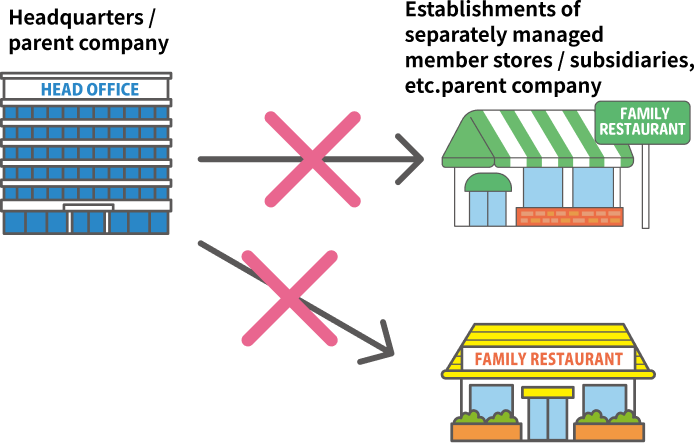
  • Examples of establishments not under the same management agency (not considered a head office / branch office relationship)

    Examples of establishments not under the same management agency (not considered a head office / branch office relationship)

    • Headquarters of a franchise or chain business and its member stores (separately managed)
    • Establishments of group companies, such as a parent company and its subsidiaries, affiliates, etc.
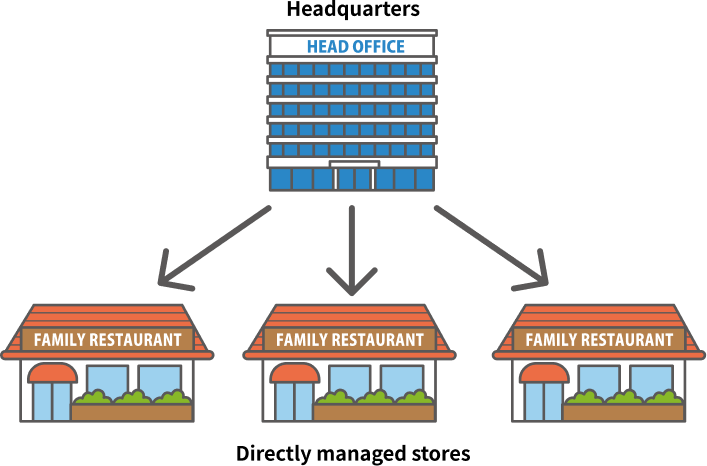
  • Examples of establishments under the same management agency (considered a head office / branch office relationship)

    Examples of establishments under the same management agency (considered a head office / branch office relationship)

    • Headquarters of a franchise or chain business and its directly managed stores
    • All stores managed by a business owner (enterprise) who manages franchise or chain member stores
Differences from the Economic Census for Business Frame

The Economic Census for Business Frame conducted in 2024 is a survey aimed at capturing basic attribute information, such as the names and locations of establishments and enterprises, descriptions of main business activities, and the number of workers. On the other hand, the Economic Census for Business Activity focuses on capturing the actual state of enterprise business activities, including sales (revenue) amounts, expenses, and capital investment amounts.


Implementation of Census

There are two primary survey methods.

  • Enumerator Survey: Enumerators visit establishments to conduct the survey
    Direct Survey: The national government sends survey documents directly to the target establishments
  • The method used depends on factors such as the scale of the establishment.

How to respond

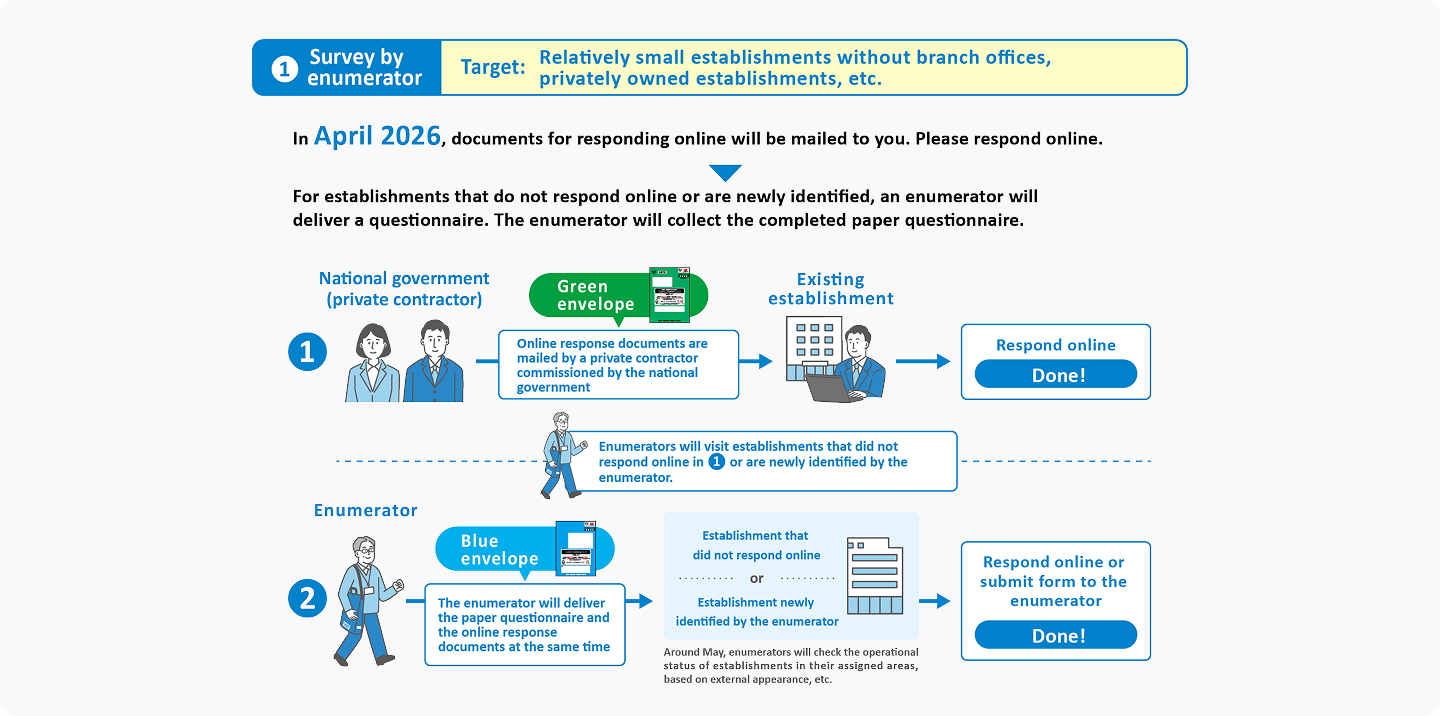
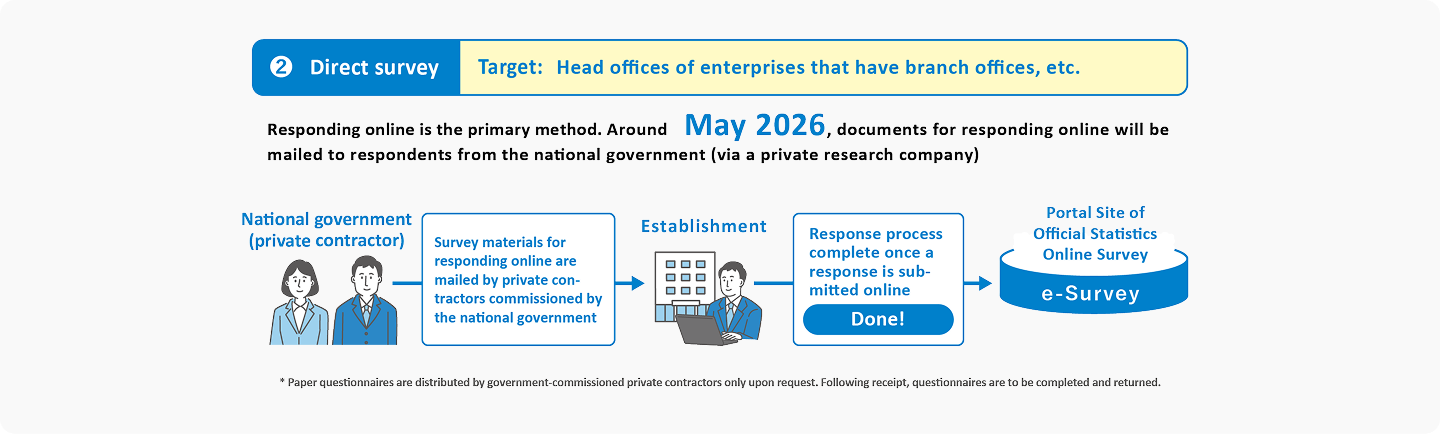
  • Regardless of the survey method, census documents for online response (available in Japanese only) are initially sent to target enterprises and establishments. The response
    process is considered complete once a response is submitted online.
  • Regarding enumerator surveys, paper questionnaires will be distributed at a later date to establishments for which an online response cannot be confirmed, with a request for response.
  • Enumerator survey
    • This survey primarily targets (relatively small) single-unit establishments without branch offices, privately owned establishments, and establishments newly identified by enumerators.
    • Separate responses must be submitted by each individual establishment.
    Establishments subject to the Enumerator Survey will receive green or blue envelopes.
  • Direct survey
    • This survey primarily targets multi-unit enterprises with branch offices, etc. and relatively large single-unit establishments, such as those with capital of 100 million yen or more.
    • The head office must submit responses that include information for all subordinate establishments.
    Establishments subject to the Direct Survey will receive a yellow envelope.
    Click here for the dedicated
    Direct Survey website

About the enumerator survey

Target: Relatively small establishments without branch offices, privately owned establishments, etc.
About the enumerator survey
What is an enumerator?
Enumerators are part-time local public servants appointed by prefectural governors. They explain the purpose and methodology of the survey to the target establishments, and perform tasks such as requesting and collecting survey responses.
Census schedule
  • Mailing of online census documents

    From early to mid-April

    • Prior to the distribution of census documents by enumerators, the national government will utilize private sector contractors to mail the necessary census documents for online responses to establishments already identified through the 2021 Economic Census for Business Activity or other statistical surveys.
    • The response process is completed once the respondent confirms the received documents and submits their response online by the specified deadline.
  • Understanding the operational status of establishments

    From around May

    Enumerators will physically walk through their assigned areas to confirm the operational status of target establishments based on their external appearance and other factors. During this process, they will also enter large commercial facilities and office buildings as necessary to carefully identify establishments that are subject to the census.
    * Even if you have submitted your response online, an enumerator may still walk through their assigned area and verify the current status of your establishment based on its external appearance, etc.
  • Distribution of questionnaires, etc.

    By May 31

    After confirming their operational status and other details, enumerators will visit target establishments to deliver survey questionnaires and other documents. These documents will be distributed to establishments for which an online response could not be confirmed and to establishments newly identified by the enumerators.
  • Collection of questionnaires

    From June 1

    • Please complete your online response by June 8.
    • For establishments that requested to submit a paper questionnaire or whose online responses could not be confirmed, an enumerator will visit to collect and verify their questionnaire. Paper questionnaires are available in seven foreign languages.
      * Note: Even if you have already submitted your response online, depending on the timing, an enumerator may still visit. Thank you for your understanding.

About the direct survey

Target: Head offices of enterprises that have branch offices, etc.
To establishments that respond to the Annual Business Survey every year:
■2026 is the year for the Economic Census for Business Activity

Conducted once every five years, 2026 is a reference year for the Economic Census for Business Activity. For this reason, the Annual Business Survey will not be conducted in 2026.

■ In addition to items from the Annual Business Survey, you will be required to provide basic information regarding your establishment.
  • The survey items for both surveys are largely the same; both aim to capture the actual state of business activities of enterprises and establishments, including sales (by business category, etc.), major expenses, number of workers, and business descriptions.
  • Note: In addition to items from the Annual Business Survey, the census also includes items such as basic information and sales for each individual establishment.
■ In the case of multi-unit enterprises

The Economic Census for Business Activity is a complete enumeration of enterprises and establishments. Therefore, for multi-unit enterprises, the following questionnaires will be sent to their headquarters:

  • Enterprise questionnaire (for recording information regarding the entire corporation)
  • Establishment questionnaire (for recording information regarding all applicable subordinate establishments)

* Detailed information regarding the Annual Business Survey is available on the Statistics Bureau website
Statistics Bureau Home Page/Annual Business Survey

Utilization of survey results

Insights from survey results

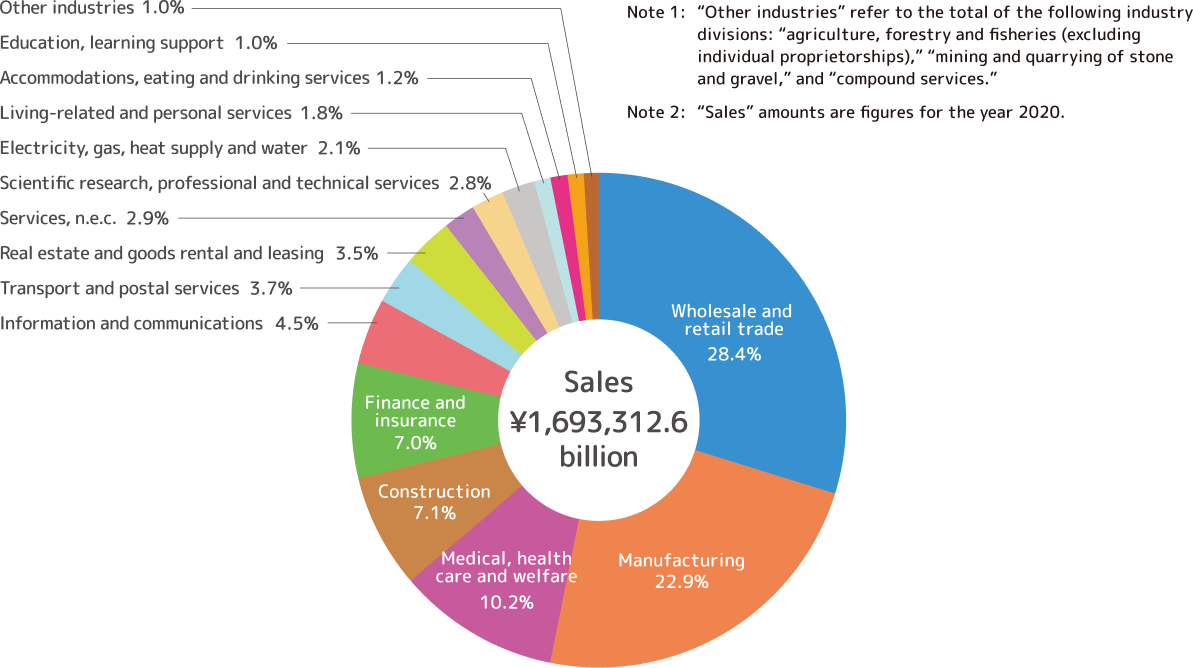
Composition ratio of sales by industrial classification of enterprises

2021 Economic Census for Business Activity

Sales \1,693,312.6 billion Wholesale and retail trade:28.4% Manufacturing:22.9% Medical,health care and welfare:10.2% Construction:7.1% Finance and insurance:7.0% Information and communication:4.5% Transport and postal services:3.7% Services, n.e.c.:2.9% Scientific research,professional and technical services:2.8% Electricity, gas, heat supply and water:2.1% Living-related and personal services:1.8% Accommodations, eating and drinking services:1.2% Education, learning support:1.0% Other industries:1.0%

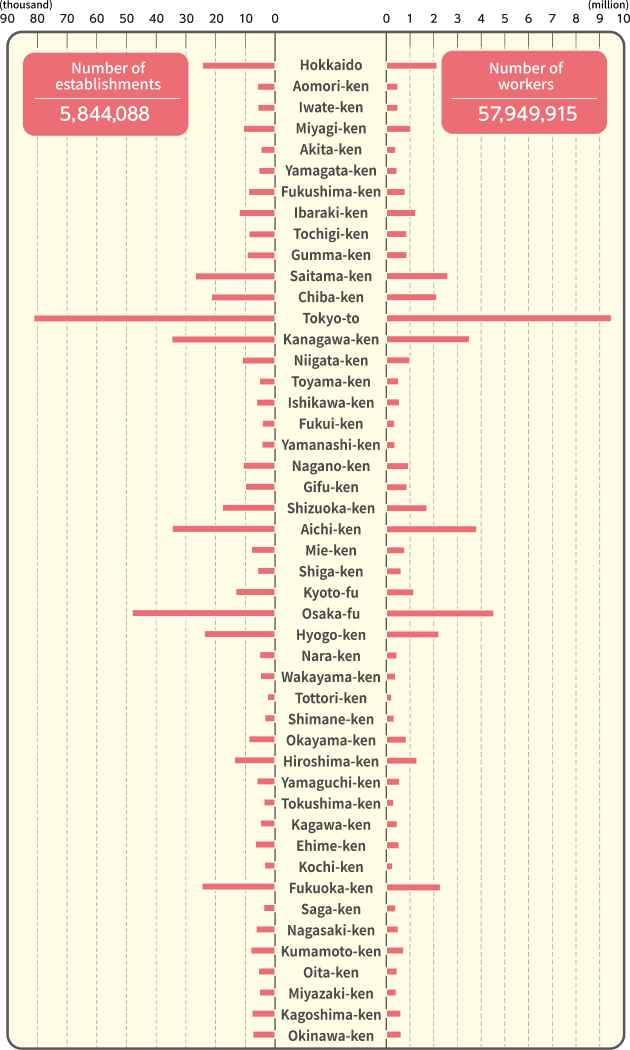
Number of establishments and number of workers by prefecture

(results of the 2021 Economic Census for Business Activity)

Number of establishments 5,844,088 Number of workers 57,949,915

In this way, by aggregating data by industrial classification and region, it is possible to grasp the status of business activities and elucidate fluctuations and trends in Japan’s overall economic activities.

Examples of utilization

Data obtained from the Economic Census for Business Activity is widely utilized as fundamental information supporting social and economic development. It informs the drafting of administrative policies by national and local governments and the formulation of business plans by private-sector companies.

  • Urban development
    • Understanding regional industrial structures and analyzing employment status
    • Visualizing the distribution of establishments and applying that to urban development measures
    • Urban planning and transportation infrastructure development
    • Measures for regional economic revitalization
    • Incentive strategies for attracting enterprises
  • Disaster prevention
    • Formulation of regional disaster prevention plans
    • Provision of support by identifying the distribution of logistics facilities
    • Estimation of economic damage in earthquake impact assessments
    • Improving the accuracy of disaster risk assessments
  • Support for
    child-rearing
    • Mapping the distribution of childcare facilities and related services
    • Planning for the construction of new daycare centers
    • Measures to address the issue of children on childcare waiting lists
    • Support for balancing child-rearing and work
  • Transport and infrastructure
    • Developing road infrastructure and designing public transport routes
    • Improving freight transport efficiency based on logistics industry distribution data
    • Formulation of regional transport plans, such as subway demand and the benefits of parking infrastructure improvement
  • Business strategies
    • Understanding the distribution of establishments and workers by industry
    • Evaluation of strategies for new store openings
    • Analyzing regional employment status
    • Identifying changes in industrial structures
    • Exploring methods for utilizing regional resources
  • Employment and labor policy
    • Understanding the number of workers and establishments by industry and region
    • Analysis of industrial clusters
    • Examination of vocational training and re-employment support
    • Formulation of strategies for attracting enterprises and regional revitalization
  • Tourism
    • Mapping the distribution of accommodation and food services
    • Planning the development of transport access networks
    • Evaluating the economic ripple effects of tourism on the regional economy
    • Exploring regional revitalization through collaboration with other industries
  • Education
    • Analysis of regional industrial structure
    • Examination of employment and career support
    • Reference material for supplementary social studies readers (textbooks) in elementary and junior high schools

Cooperation for the Economic Census
for Business Activity

What is the Economic Census for Business Activity?

The cooperation of all relevant organizations and associations is essential for promoting widespread awareness of the significance and necessity of the Economic Census for Business
Activity to ensure its smooth and effective implementation. Your cooperation in the census is greatly appreciated.

National government

Request for dissemination of information regarding implementation of the census to affiliated member enterprises and organizations

Central organizations

Cooperation details
  • Publication in organization bulletins or newsletters
  • Posting information on website
  • Displaying web banners
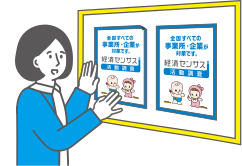
  • Displaying posters, distributing leaflets
  • Requesting information be disseminated that affiliated member enterprises and organizations, etc. are also subject to the census

Local governments

Request for dissemination of information regarding implementation of the census to affiliated member enterprises and organizations

Local organizations,
local branches

Cooperation details
  • Publication in organization bulletins or newsletters
  • Posting information on website
  • Displaying web banners
  • Displaying posters, distributing leaflets
  • Requesting information be disseminated that affiliated member enterprises and organizations, etc. are also subject to the census

Schedule

Organizations, etc.

The national government issued a written request to central organizations in December 2025. After that, local governments will sequentially issue requests to local organizations at the prefectural or municipal level.

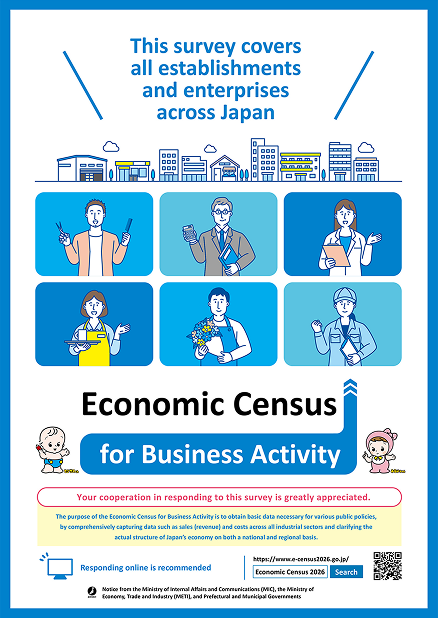
Leaflet for requesting cooperation

  • Leaflet Image
Download leaflet for
requesting cooperation
PAGE TOP